
Paediatric Infectious Diseases and Immunology Unit
On this page:
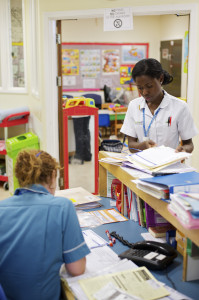
Our Paediatric Infectious Diseases and Immunology Unit provides expert care and support for children and young people with a wide range of infectious diseases and immunological conditions. Our multidisciplinary team of specialists is dedicated to offering the highest quality care, ensuring patients receive the most advanced treatments available in a child-friendly environment, in our dedicated ward Pinckney or as an outpatient or day case.
Content:
- Our services
- Our team
- Referrals
- Teaching
- Research

1. Our Services
We offer a range of services designed to diagnose, treat, and manage infectious diseases and immune system disorders in children and adolescents.
Diagnosis and Management of Paediatric Infectious Diseases and Immunodeficiencies for hospitalised children:
- We manage children with bacterial, viral, fungal, and parasitic infections.
- Our expertise includes severe infections such as sepsis, meningitis, bone and joint infections, etc as well as HIV, tuberculosis, congenital infections and infections in the immunocompromised host.
- We work jointly with colleagues from other specialities at St. George’s University Hospital (general surgery, neurosurgery, ENT, ophthalmology, trauma and orthopaedics, Allergy, Respiratory, Haematology/Oncology, Dermatology, PICU and NICU, Adult Infectious Diseases and Microbiology at SGH, Adult Immunology Team at St Heliers).
Immunodeficiency and Vaccine Services:
- Comprehensive diagnostics for primary and secondary immunodeficiencies.
- We manage the full spectrum of primary and secondary immunodeficiencies, and immune‑dysregulation disorders. We do not provide gene therapy or bone‑marrow transplantation on site, but work closely with quaternary centres and offer ongoing local follow‑up for these patients.
- Home care service for patients requiring immunoglobulin replacement therapy.
- Vaccination advice for children with immunodeficiencies, those who are on immunosuppressive therapies, or who have had previous reactions to vaccines (in close collaboration with paediatric allergy).
- We are the reference centre in South West Thames for SCID screening.
- We undertake research focused on immunological conditions.
- We do not deliver dedicated immunology subspecialty training, but our Paediatric Infectious Diseases trainees attend immunology clinics to gain supervised clinical exposure.
Travel and Tropical Medicine:
- Pre-travel consultations for vaccinations and advice on travel-related infections.
- Post-travel assessments for children returning with fevers or other symptoms of tropical diseases, such as malaria or dengue fever.
Antimicrobial Stewardship and Infection Control:
- Our team works to ensure the appropriate use of antibiotics and other antimicrobial treatments within Paediatric at St. George’s University Hospital.
- We collaborate with infection control teams to prevent and manage healthcare-associated infections.
Specialist Clinics:
We run outpatient clinics for children in the Dragon Children’s Centre, Ground Floor, Lanesborough Wing (unless stated otherwise).
Paediatric outpatients (SGH – Dragon Centre) – St George’s University Hospitals NHS Foundation Trust
The Centre provides wheelchair access, lifts, accessible toilets, baby‑changing facilities, child‑friendly waiting areas, and access to phlebotomy and play‑specialist support
- HIV outpatient service and adolescent clinic.
- 1st and the 3rd Thursday of the month 1330-1700
- Adolescent transition clinics are on the first Wednesday evening of the month in the courtyard clinic 1600-2000
- Congenital infections
- 1st Tuesday of the month 1330 -1700
- Paediatric tuberculosis
- 2nd and 4th Thursday of the month 1330-1700General paediatric infectious diseases
- Every Thursday 1330-1700
UASC (Unaccompanied Asylum-Seeking Children) Every Thursday 1330-1700
- Virtual fungal clinic (monthly)
- Immunology Clinics (including vaccine consultations):
- 2nd & 4th Friday of each month, 13:30–17:00, Dragon Centre
- 3rd Wednesday of each month, 09:30–13:00, Dragon Centre
- Joint Immunology–Respiratory Clinic:
- Wednesday mornings, 09:30–13:00, held 4 times per year in the Dragon Centre
- Satellite immunology clinics: None currently provided.
To support safe and effective care, families are asked to:
- Inform us of any appointment changes
- Discuss any planned changes to treatment with the team
- Contact GP or urgent care if the child becomes unwell between appointments
- Tell us if care expectations are not being met
- Abide by our zero‑tolerance policy for aggression
- Notify us if their child is admitted to another hospital so we can offer specialist input.
You can contact a member of the team via:
Email: Childrens.SecretariesC@stgeorges.nhs.uk
Phone: 07799451617
2. Our Team
Our dedicated team includes Paediatric Infectious Diseases consultants, senior trainees, Clinical Nurse Specialists, Pharmacists and admin support.
Consultants
Katja Doerholt MD, PhD, FRCPCH
Consultant in Paediatric Infectious Diseases and Immunology.
Special interests: HIV, TB, pOPAT, Antimicrobial Stewardship, Immunology
Borbala Zsigmond MD, FRCPCH
Consultant in Paediatric Infectious Diseases and Immunology.
Special interests: Antimicrobial Stewardship, HIV, TB, autoinflammatory diseases.
Konstantinos Karampatsas MD, PhD, FRCPCH
Consultant in Paediatric Infectious Diseases and Immunology.
Special interests: Immunology, Vaccinology, Neonatal infections.
Sarah Prentice MA(Oxon), MBBS, MRCPCH, MSc, DTMH, PGDip(PID), PhD
Consultant in Paediatric Infectious Diseases and Immunology
Special interests: Global child health, tropical diseases, TB, perinatal infections, vaccinology
Nuria Sanchez Clemente, MBChB, MRCPCH, MSc, DTMH, PhD
Consultant in Paediatric Infectious Diseases and Immunology
Special interests: Migrant health, TB, congenital infection
Prof. Amaya Bustinduy MD, PhD, FRCPCH
Consultant in Paediatric Infectious Diseases and Immunology.
Special interests: Global Health, tropical diseases and Parasitic infections.
Prof. Shamez Ladhani MD, PhD, FRCPCH
Consultant in Paediatric Infectious Diseases and Immunology. Epidemiologist for the UK Health Security Agency.
Special interests: Vaccinology, infection outbreaks, COVID19
Prof. Kirsty Le Doare PhD, FRCPCH
Honorary consultant in Paediatric Infectious Diseases and Immunology. Professor of vaccinology and immunology.
Special interest: Global Health, vaccinology and Neonatal infections.
Clinical Nurse Specialists
Sharon Storey
Senior Clinical Nurse Specialist
Special interests: paediatric HIV, TB, Congenital Infections
Sarah Tizzard
Senior Clinical Nurse Specialist
Special interests: paediatric viral hepatitis, HIV, TB, Congenital Infections
Clare Gilmour
Senior Clinical Nurse Specialist (Immunology Lead)
Special interests: Immunology, paediatric HIV, TB, Congenital Infections
Emma Le Boutiller
Clinical Nurse Specialist
Special interests: paediatric HIV, TB, Congenital Infections
Jaroslava (Jay) Alam
Senior Clinical Nurse Specialist
Special interests: pOPAT (Paediatric Outpatient Parenteral Antimicrobial Therapy) and venous access
Natasha Alleyne
Senior Ward Nurse
Pinckney Ward Manager
Secretary
General Manager
Bethea Hanson-Jones
3. Referrals and Consult advice
We accept referrals from general practitioners (GPs), paediatricians, and other healthcare professionals for children with suspected or confirmed infectious diseases or immune system disorders. We cannot provide advice directly to patients or families without a formal referral from primary or secondary care.
Referral Pathway:
Pathway Standards
New referrals: Seen within national outpatient waiting time standards.
Urgent referrals: Seen within 2 weeks where clinically indicated.
General practitioners:
GP can refer via ERS Paediatric Infectious Diseases @ St George’s University Hospital – RJ7
Other health care professionals can refer via email: RMC@stgeorges.nhs.uk
Referrals for pOPAT can be done via the intranet:
- pOPAT form
With any queries about pOPAT please referred to: Jaroslava (Jay) Alam. Ex 0677, bleep 6088
Referrals for the assessment of UASC (Unaccompanied Asylum-Seeking Children) can be done by filling in the form below and emailing it to: uasc@stgeorges.nhs.uk
- UASC referral form
Home immunoglobulin therapy: Provided by immunology CNS team
We offer a consultation service to health care professionals in South West London. This can be done to our Paediatric Infectious Diseases registrar via Switch board or via email: tb/pidconsultadvice@stgeorges.nhs.uk. We will request a referral form to be fill in.
- Referral form
Resources for families:
Please see the patient information leaflets from the Trust website.
Patient Support Groups:
- Immune Deficiency UK
- CHIVA
- CMV Action
- AT Society
- BAPT
- GBSS
4. Education and work experience
We are actively involved in providing training opportunities for healthcare professionals and are one of several national training centre for Paediatric Immunology and Infectious Diseases (PIID) in the UK.
Undergraduate
We collaborate closely with City St Georges University of London by supervising SSC (student selected component) placements and other undergraduate medical student research and healthcare service evaluation projects, offering insight and encouraging interest in PIID.
Postgraduate
Our unit actively collaborates in the training of resident doctors. Our day-to-day clinical service is supported by a team of resident doctors one F1, three paediatric ST1-ST4 trainees and two to three ST5-ST7 trainees), led by a consultant. Our resident doctors are involved in both inpatient and outpatient activities as well as in clinical governance, audits and research projects. Our ST5-7 trainees are drawn from both the PIID sub-specialty training programme and from the general paediatrics training pathway.
We support Integrated Academic Training (IAT) through offering regular National Institute for Health Research (NIHR)-funded opportunities for Academic Clinical Fellowship (ACF) and Clinical Lecturer (CL) posts. These posts provide structured pre-doctoral and post-doctoral academic training and experience at City St George’s, University of London, alongside clinical training in the trainee’s specialty (e.g. general paediatrics, PIID, or neonatology). These posts are advertised annually and subject to competitive entry. The posts aim to train future academic leaders in paediatrics who are capable of developing further centres of excellence. City St George’s University of London offers a comprehensive programme of research skills training for staff, and George’s Academic Training (GAT) supports ACFs and CLs through mentoring, formative appraisal, and networking events. Integrated academic trainees at St George’s have the opportunity to study for a Postgraduate Certificate in Healthcare and Biomedical Education, Postgraduate Certificate in Genomics, or a Postgraduate Certificate in Healthcare Research Skills and Methods.
We offer an annual position for a Paediatric Infectious Diseases Clinical Fellow. This opportunity is open to senior trainees or early-career consultants from the UK and overseas who wish to expand their knowledge in this field for 6 or 12 months. For more information please, contact our secretary (archana.pydegadu@stgeorges.nhs.uk).
We accept overseas Observers. This role is particularly designed for overseas doctors in training who are seeking experience in a tertiary care Paediatric Infectious Diseases Unit in the U.K. Clinical observers are organised so there is a maximum of one trainee during the rotation. This observer is involved in the inpatient and outpatients review as well as an audit/guideline review. For more information please, contact our secretary (archana.pydegadu@stgeorges.nhs.uk).
External observers training programme LFA (Word)
5. Research
We are involved in cutting-edge research to improve the diagnosis and treatment of infectious diseases and immunodeficiencies in children. Our Unit is closely related to the Centre for Neonatal and Paediatric Infection (CNPI), at City St George’s University of London which is an internationally recognised centre leading global Paediatric Infectious Diseases Research. The CNPI includes a research portfolio comprising a variety of projects and studies in children, with a focus on the epidemiology and treatment of vaccine-preventable diseases (Professor Paul Heath, Professor Shamez Ladhani, Dr Sarah Prentice), global antibiotic resistance and prescribing (Professor Mike Sharland and Dr Julia Bielicki), global neonatal health and maternal vaccination (Professor Kirsty Le Doare, Dr Kostas Karampatsas, Dr Sarah Prentice), congenital infections, health inequalities and migrant health (Dr Nuria Sanchez Clemente), and on infant feeding, gut microbiome, and antimicrobial resistance (Dr Rosie Crane).