
Prosthetic and amputee rehabilitation
On this page:
A prosthetic service has been available at Queen Mary’s Hospital since the First World War. It has developed into an internationally recognised service offering highly specialised services for amputees.
Our prosthetic team feature in this short film – you can watch to find out more about the important work they do:
Services offered
The service offers artificial limb assessment, prescription, manufacture, fitting and training for patients with upper and/or lower limb amputations, or limb deficiency. This is delivered by a multidisciplinary team and led by a consultant in rehabilitation medicine. The service works with clients to assess their needs, rehabilitate them into the community and help them achieve function, mobility and independence. This is available as either an inpatient or an outpatient.
Facilities
- Examination rooms
- Prosthetic cast and fitting rooms
- Prosthetic factory on site
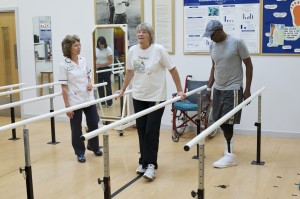
- Therapy treatment gym
- Occupational Therapy functional assessment rooms
Amputee rehabilitation at Queen Mary’s
Amputee rehabilitation has been an established service at Queen Mary’s Hospital, Roehampton for over 100 years. . The history of Queen Mary’s began with the rehabilitation of service personnel who had lost limbs during World War I. Amputee rehabilitation has continued to be a service at the hospital ever since.
In 2006, the Douglas Bader Rehabilitation Centre – named after Douglas Bader, the RAF pilot who lost both his legs in World War II – was created within the new Queen Mary’s Hospital and provides a specialised multidisciplinary service to amputees from south west London and the region extending to the borders of Surrey and Sussex. Referrals from further afield are considered and may benefit from the range of specialist services, clinical expertise and facilities available.
Amputees are rehabilitated as either inpatients on the Gywnne Holford Ward, which has 10 beds dedicated to amputee rehabilitation, or as outpatients.
All amputees must be referred to the centre by a GP or hospital consultant. A referral form must be completed or, in the case of being referred from out of the region, a letter must be sent to Dr Vijay Kolli, Consultant in Rehabilitation Medicine.
If you would like more information on amputee rehabilitation services or would like to feedback to us please do get in touch with us. You can find out how on the contact us section.
Contact details
Douglas Bader Rehabilitation Centre
Queen Mary’s hospital
Roehampton
London
SW15 5PN
Email for referrals/referral queries/patient queries
QMH.AMPRehabReferrals@stgeorges.nhs.uk
General enquiries email
Therapy enquiries emails
Amptherapies.QMH@stgeorges.nhs.uk
Telephone advice
020 8487 6030 – Vitali Clinic
Secretaries
020 8487 6800
Douglas Bader Centre reception
020 8487 6001/2/3
Vitali clinic (outpatients)
020 8487 6030
Gwynne Holford Ward (inpatients)
020 8487 6128
Prosthetics department
020 8487 6045
Physiotherapy (rehab gym)
020 8487 6042
Occupational Therapy
020 8487 6139
Social worker
020 8487 6810
Clinical psychologist
020 8487 6140
Bader Gymnasium
020 8487 6040
Opening hours
Monday to Friday 08.00-04.00pm
Opening hours
Monday to Friday 08.00-04.00pm
Location
Treatments
Who would benefit from coming to Queen Mary’s?
Following amputation surgery, you will be referred to Queen Mary’s if the team in your hospital where you have had surgery believe you will benefit from the services we provide. If you are recovering well, you will be seen within a few weeks.
The decision about whether to have a prosthesis depends on several factors, and every effort is made to make sure the right decision is made in discussion with you. As well as assessing you physically, your personal circumstances will be reviewed (for example, housing and family support) to establish whether you can manage the rehabilitation programme and will benefit from having a prosthesis.
Most of the 35 NHS amputee and prosthetic services only offer outpatient rehabilitation, but Queen Mary’s can offer both inpatient and out patient rehabilitation
After a full MDT assessment , the team will decide on a case-by-case basis if you would benefit from having rehabilitation as an inpatient. If you are suitable for inpatient rehabilitation, there can be a few weeks waiting period which is dependent on several factors.
A prosthesis is not always the best option following amputation. It requires a lot of energy and hard work to learn how to use it safely and properly and for a proportion of patients, a wheelchair is a safer and more functional option. If during this assessment period you and the team decide that the use of a prosthesis is not the best option at this time, the team will suggest alternative options. If in doubt, they may re-assess you after some weeks and suggest some exercises/ therapy input in the community before making a final decision.
The rehabilitation process at Queen Mary’s Hospital, Roehampton – what happens?
Outpatient Rehabilitation Pathway
The rehabilitation process starts when you have been assessed by the team and your suitability for rehabilitation and treatment goals have been discussed and agreed with you. In most cases, the main goal is for you to learn to use your prosthesis in the most functional and useful way, and to the best of your ability.
If the use of a prosthesis is appropriate, you will be measured for and fitted with a prosthesis and, return for fitting and training. If you are a lower limb amputee it is recommended you attend therapy on a regular basis, 3-4 afternoons a week, to learn to use your prosthesis most effectively; for upper limb amputees, rehabilitation may happen once weekly. As part of treatment, you will receive advice, information and health education, and you will be encouraged to self-manage your rehabilitation programme. The team works closely with your referring hospital, social services and other organisations as necessary, for your benefit. Please see the patient information leaflet for further details of the rehabilitation process. Referral for limb fitting at the Douglas Bader rehab centre
Inpatient Rehabilitation Pathway
Admission criteria
Rehabilitation admission criteria for Gwynne Holford ward from hospital or home
- 18+ years of age with a major lower limb or upper limb amputation, or both, or revision surgery
- medically stable without need for IV treatment or regular acute or specialist medical/nursing management
- Stable diabetes control with no severe hypoglycaemic events or hyperglycaemic events with BM>28 over the preceding 48 hours
- assessed by the MDT as able to actively participate in an intensive rehabilitation programme over 7weeks on average
- patient centred achievable goals agreed with the patient and their family/care
- discharge destination identified before admission either to:
- current home address
- an interim placement ,
- Repatriation to referring hospital,
- a rehousing referral has been completed prior admission.
- wounds must be sufficiently healed to enable rehabilitation to commence e.g provision of compression therapy and use of early walking aids and able to start weight bearing on residuum – photographs of complex wounds must be sent with the referral
- assessed for a wheelchair and onward referral made
- access visit completed and report received
Exclusion criteria
- a current problem with untreated or managed alcohol/substance misuse
- unstable behavioural or mental health conditions needing specialist management
- identified as in need of end-of-life care
- Does not meet prosthetic borderline criteria
- Unable to transfer independently
- Unable to manoeuvre and manage wheelchair with associated transfers
- Unable to carry out personal care tasks
- Unable to stand
- Fixed flexion deformity at hip or knee
- severe cognitive impairment identified
- if patient requiring vacuum-assisted closure (VAC) therapy to stump wounds, this would need to be discussed on a case-by-case basis
- patients who are ineligible to receive NHS-funded rehabilitation care
As an inpatient you may arrive shortly after surgery, and you will need a period of rehabilitation before you are ready to use a prosthesis. For all amputees learning to use your prosthesis safely and functionally can take anything from six to eight weeks, sometimes longer. All patients will continue to receive rehabilitation for as long as is necessary. However, it may be necessary or more appropriate for you to continue part of your rehabilitation at your local hospital where the surgery was performed, and you will therefore be discharged within a shorter period. Some patients may have an initial rehabilitation period and then return some months later for further intervention.
Treatment will be provided on a daily basis in the mornings with education and functional sessions in the afternoons. Please follow link for more details about the ward.
Gwynne Holford ward amputee rehabilitation service (PDF)
Discharge planning as an inpatient
The team will carefully plan for you leaving Queen Mary’s and make sure necessary services are in place.
If you are continuing your rehabilitation at your local hospital, or from the community services, your therapist will discuss this with you and organise it before you are discharged.
If you need help with managing at home this will be organised between the occupational therapist and social worker at Queen Mary’s, their colleagues in your local hospital and/or social services. If it has been identified that it isn’t possible for you to return home, plans will be discussed with you during your admission for a discharge destination.
On Completion of Rehabilitation as either Inpatient or Outpatient
When you complete your rehabilitation, you will be given the names and telephone numbers of people to contact if you have any problems. You will be given a routine follow-up appointment for six weeks after you have been discharged from therapy to assess how you are managing. After that you can make further appointments as necessary.
The Patient Support User Group (Roehampton Limb User Group-RLUG) is an inclusive patient driven contact point for amputees or those with limb difference and orthotic patients who attend Queen Mary’s Douglas Bader Rehabilitation Centre, Roehampton. Our quarterly meet-ups on health and life topics plus peer experience of practical independent living tips allow better reablement. We also keep abreast of prosthetic and orthotic developments ensuring that Roehampton limb service users receive the best NHS service standards for our individual needs. Our varied social events book up quickly. We come together with other limb charities and neighbouring user and support groups. If you are already a limb user patient at Queen Mary’s look out for our publicity by the gym. Keep informed by emailing hello@r-lug.org.uk
Key staff
The amputee multidisciplinary team aims to provide a high-quality service to upper and lower limb amputees, adults and children. Staff are committed to providing the most effective practice and service that is innovative and efficient, supported by on-site professional education, research and development. There is a range of different clinics including pain assessment and children. Please note that whilst amputation surgery is not performed at Queen Mary’s there is a pre-amputation consultation clinic to discuss potential and expectations of post amputation rehabilitation.
The team works together with you and your family to optimize psychological, social and physical functioning with or without a prosthesis (artificial limb). The team aims to create a flexible and enjoyable environment where everyone is respected and valued.
“You will meet a wide range of health care professionals involved in your care. The amputee rehabilitation team is a specialist team led by the Consultant in Rehabilitation Medicine, Dr. Vijay Kolli.
- Consultant in Rehabilitation and the Medical Team
The consultant is responsible for your overall clinical care and works closely with the other members of the team. The doctors, although not surgeons, are experts on amputation surgery, pain management, diabetes and other general medical problems relevant to amputee rehabilitation and are able to identify any relevant rehab/ health issues during or after your rehabilitation and either initiate treatment or signpost to other services/GP as appropriate.
- Nursing Staff
The nursing staff are responsible for helping you care for yourself during your stay if you are an inpatient. Nurses also run the outpatient clinics and give nursing care to amputees attending. The nurse’s role is both educational and advisory giving advice on stump care and the management of any wounds and if required can liaise with district nurses to ensure continuity of wound care.
- Prosthetists and limb manufacturing
The prosthetist is the person who makes and fits your prosthesis. The Prosthetics Department based at QMH provides the limb fitting service and all the relevant expertise that surrounds it, both clinically and technically, supported by an on-site modern prosthetics workshop.
- Amputee Therapy Team
Physiotherapists, Occupational Therapists and the rehabilitation assistant make up this team. The physiotherapist focuses on exercise, strength, balance and mobility, in particular with your prosthesis. The occupational therapist enables you to adapt and regain independence in everyday activities and, may visit your home to recommend appropriate equipment and adaptations.
- Medical Social Worker
A social worker is available to see you on the ward and also as an outpatient, and offers help and advice related to housing, care and benefit issues.
- Clinical Psychologist
The psychologist provides emotional and psychological support to help you adjust to changes that amputation can bring to your life.
The team collaborates closely with and has access to other on-site services and specialists including dietetics, a diabetes clinic, x-ray department, a fully equipped gymnasium, wheelchair services, special seating, orthotics and a gait laboratory.
Ward
Gwynne Holford Ward (Rehabilitation)
Referrals
Roehampton rehabilitation referral form (Excel)
Roehampton paediatric rehabilitation referral form (Excel)
(Please use Google Chrome or Mozilla Firefox web browsers to open form).
If you are unable to open the referral document, please email Qmh.amprehabreferrals@stgeorges.nhs.uk and a referral form will be emailed to you for your completion.
Patient information
Gwynne Holford ward amputee rehabilitation service (PDF)
Referral for limb fitting at the Douglas Bader rehab centre (PDF)
Opening hours
Monday to Friday 08.00-04.00pm