

Head and neck cancer
On this page:
Many symptoms that are experienced gradually improve over time, being aware of what is ‘normal’ for you can help you notice if any additional support is needed.
What follow up you will have
After treatment, these are the appointments to expect to continue with
| Year 1 after your treatment | 2 monthly outpatients appointments based at St George’s hospital |
| Year 2 after your treatment | 3 monthly outpatients appointments based at your local hospital |
| Year 3 after your treatment | 4 monthly outpatients appointment at your local hospital |
| Year 4 after your treatment | 6 monthly outpatients appointment at your local hospital |
| Year 5 after your treatment | After 5 years of surveillance, in most cases, you will be discharged from the head and neck team |
If you have had radiotherapy to your neck, we would also recommend an annual thyroid function test.
Signs and symptoms to be aware of – when to ask for help
Please remember, not every symptom means that the cancer has returned. Many symptoms are related to the long-term effects of treatment, other conditions, or the normal recovery process. However, it is always important to get persistent, worsening or worrying symptoms checked out.
If you experience any of the following symptoms for more than three weeks, please get in touch with the St Georges, head and neck cancer nurse specialist (CNS) team on 02082753263
- Persistent sore throat
- Foul smelling breath
- Hoarseness or voice changes
- Swelling of your throat
- Persistent earache or pain
- A lump, bump or mass you can feel that isn’t painful
- A white or red patch
- Persistently congested or blocked nose
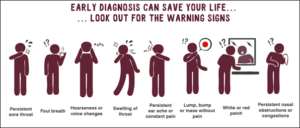
Image copied with permission from The Swallows Head and Neck Cancer Support group awareness posters
The late effects of head and neck cancer treatment
Treatment side effects vary from one person to another.
Some people experience a dry mouth, treatment can change the amount of saliva that you produce and this can make your mouth feel dry. It is important to continue with your regular dental and mouth care routines. Tips on managing a dry mouth can be found here
Some people can experience a sore mouth after radiotherapy. Please see the following page for more information – Mucositis (mouth or throat soreness and mouth ulcers)
Treatment may affect your speech or voice. Please see the SLT page for more information.
Jaw, shoulder and neck stiffness can develop after surgery and radiotherapy. After your surgery, you may feel more comfortable staying still and sitting in a slumped position. Sitting and standing in a good upright posture can help to keep your muscles and joints in a good position. Regular movement is helpful to manage stiffness that might develop. When your wound has fully healed, it is helpful to massage your wound to relieve the tightness that naturally develops as it heals. Your team may recommend some specific exercises that you can do to help relieve this stiffness. If your movement is limited and not improving with these exercises, please ask your GP to refer you for physiotherapy.
After surgery and radiotherapy, some swelling of your face and neck is common. Some people can develop lymphoedema. For more information about this please see the Lymphoedema pages
Please ask your team to refer you to the monthly lymphoedema workshop if you would like to learn more about lymphoedema or you have developed swelling.
Treatment for head and neck cancers can change the way you look, or the way you feel about your appearance. Advice and guidance on managing body image concerns can be found here.
The Changing Faces Charity also provides support to people with a scar, mark or condition on their face or body.
Tiredness or fatigue is common after cancer treatment. Please join our regular workshop and see our Fatigue webpages for more information about how to manage your energy levels after cancer treatment
If your fatigue persists and you have had radiotherapy to your neck, please ask your team to check your thyroid function and this is one potential cause for persistent fatigue after radiotherapy.
Changes to sex and intimacy, if you are coping with the effects of head and neck cancer treatment, it may affect your confidence, libido and energy levels. Please see Sex, intimacy and cancer for more information and advice about these potential changes.;
Resources
More information is available on the Macmillan website
Long term and late effects | Head and neck cancer | Macmillan Cancer Support
And in this booklet
https://www.macmillan.org.uk/cancer-information-and-support/stories-and-media/booklets
Head and Neck Cancer support groups and charities
Head and neck cancer networking group – Maggie’s at the Royal Marsden
This support group offers information, advice and support for people living with or beyond head and neck cancer. Meeting in person usually on the first Friday of the month, 2pm to 3pm
Telephone number: 020 3982 3141
maggies.royalmarsden@maggiescentres.org
The swallows Head & Neck Cancer Support Group
24/7 support line 07504725059
info@theswallows.org.uk
Oracle Head and neck cancer UK
info@oraclehnc.org.uk
Heads2gether
24/7 helpline 0800 023 4550
Butterfly Thyroid Cancer Trust
07399 564 463
amy@butterfly.org.uk
Mouth Cancer Foundation
020 8940 5680
info@mouthcancerfoundation.org