
First robot heart op patient thanks NHS team as he can “move on with life”
A patient has spoken of his gratitude to the NHS after he received life-saving robotic surgery – as hundreds more patients across London and Surrey are set to access the cutting-edge technology.
Paul Wickens, who lives in St Mary’s Bay in Kent, was one of the first heart disease patients at St George’s Hospital in Tooting to receive robotic-assisted surgery – an innovative procedure minimising recovery time for heart operation patients.
Care worker Paul had lived with the condition for 24 years and his symptoms had deteriorated in recent years, leaving him “tearful” over what this could mean for his health.
The 66-year-old support worker was given new hope when he had a robotic coronary artery bypass grafting (CABG) surgery in December 2025 – one of the first of its kind at the hospital group, one of only three units in London who can perform the innovative procedure.
His surgery was assisted by one of two da Vinci surgical robots – one of the most advanced systems of its kind – at St George’s, which have resulted in fewer complications for patients, lower readmission rates and shorter length of stays across other specialities.
Now, more patients like Paul across Surrey and London are set to benefit from a brand new da Vinci Xi surgical system now at Epsom Hospital, enabling surgeons to carry out more life-saving procedures on hundreds of patients every year.
Paul said: “I didn’t really understand what robotic surgery involved, but I felt very trusting of the surgical team and was immediately put at ease.
“I was in a little pain afterwards, although it was managed well with medication, and I was able to talk to my family that afternoon.”
Traditional surgery for coronary artery bypasses typically involves an incision in the middle of the chest (sternum) with multiple bypass grafts.
Robotic-assisted surgery is less invasive, using small incisions and a high-definition 3D camera to allow greater precision. This results in less damage to surrounding tissue, reduced blood loss and lower levels of post-operative pain.
Paul returned home within four days rather than the week in hospital that is typically expected. He is planning on returning to his role in the care sector next month, where he has worked for the past thirty years.
He added: “I am so grateful and lucky to be born in a time when such technology has come to the fore and I can’t thank the team enough – my symptoms have gone and I can move on with my life.”
Dr Richard Jennings, Group Chief Medical Officer for St George’s, Epsom and St Helier University Hospitals and Health Group, said: “We are embracing the latest technologies including robotic-assisted surgery, to improve care for thousands of patients – cutting waiting times, speeding up recovery and getting patients home sooner.
“Paul is one of many patients we expect to treat with robotic-assisted surgery in the coming years, in a major step forward for our hospitals. I’m very pleased that Paul is doing so well and I am proud of the way our teams are working together every day to provide innovative, safe and up-to-date care to our patients.”
The debut cardiac procedure is leading the way in the hospital group’s commitment to using innovation to improve patient outcomes and recovery times.
The new robotic da Vinci system, part funded by Epsom and St Helier Hospitals Charity, will be shared by surgical teams from Epsom and St Helier and St George’s hospitals – with the first patients being treated this week.
It will be used for a range of procedures including general surgery, colorectal cancer surgery, and gynaecological surgery as well as urology and ENT (ear, nose and throat) procedures.
It is expected to treat around 300 patients in the first year, rising to over 550 annually as more surgeons complete specialist training.
Molly Simpson, Head of Charity and Fundraising for Epsom and St Helier Hospitals Charity said: “We’re incredibly proud to help more local people access cutting-edge surgery by part-funding the new surgical robot at Epsom Hospital.
“Thanks to our generous donors and fundraisers, we’re able to make every penny count and deliver real benefits for patients.”
Professor Marjan Jahangiri, Consultant Cardiac Surgeon at St George’s University Hospitals NHS Foundation Trust, said: “We are delighted with Paul’s recovery and with the success of our first ever robotic-assisted surgery for cardiac cases at St George’s Hospital.
“We are excited to develop and further progress the use of this innovative hardware to help us provide more precise care for the patients and allow for a faster recovery.

Paul Wickens, 66, from St Mary’s Bay in Kent was one of the first patients to receive robotic surgery for a cardiac case at St George’s Hospital in Tooting.

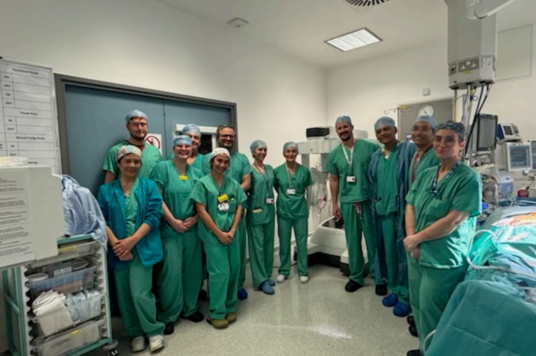
The robotic cardiac team comprised of Professor Jahangiri, Mr. Smelt and Mr. Hussain, cardiothoracic surgeons and a dedicated team of anaesthetists and nurses.

The da Vinci Xi is a new robotic system, part funded by Epsom and St Helier Hospitals Charity which is based at Epsom Hospital and will shared by surgical teams from Epsom, St Helier and St George’s hospitals.