

Sphincter Exercises
On this page:
Having well-functioning sphincter muscles can help to improve bowel control. When done correctly, these exercises can build up and strengthen the muscles to help you to hold both gas and stool (poo) in the back passage.
Where are these muscles? The back passage or anus has two rings of muscle around it.
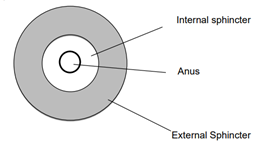
Internal sphincter (this is the inner ring). You have no control over this muscle, which should always be closed except when you are trying to open your bowels. This is normally automatic; you don’t have to think about it. You cannot exercise or strengthen this muscle.
External sphincter (this is the outer ring). This is a voluntary muscle which you can tighten up to close it more firmly if you have urgency or diarrhoea. This muscle can be exercised and strengthened.
Both muscles wrap around the anus. When a stool comes into the rectum, the internal sphincter relaxes and allows the stool to enter the top part of the anus. Very sensitive nerves in the anal canal can tell you if it is wind or stool waiting to come out. If it is stool, you squeeze your external sphincter to stop it from coming straight out. This squeezing moves the stool back into the rectum, where it waits until you get to the toilet.
Either or both sphincter muscles can become weak. This may be because of constipation and straining, surgeries involving the anus and rectum, radiotherapy or targeted therapy, childbirth, or general weakness with ageing. Sometimes there is no obvious reason why. If you have weak muscles and cannot squeeze enough to hang on, you will feel urgency and may leak wind, liquid or even solid stool.
How can I strengthen them?
Like any other muscles in the body, the more you use and exercise the sphincter muscles, the stronger they will become.
- Locate the muscles: in sitting with your knees slightly apart, pretend you are trying to hold in a bowel movement or prevent yourself from passing wind. You should feel the muscles around your anus start to tighten.
- Try to squeeze and lift these muscles as hard as you can. It is important to continue to breathe normally when contracting your muscles and NOT hold your breath. You should NOT squeeze your buttocks, tummy or legs when you do this exercise.
- If you are unsure that you are exercising the right muscle, put a finger on the anus as you squeeze to check. You should feel a gentle lift and squeeze if you are exercising the right muscle. Alternatively, look at the area in the mirror; you should see the anus pucker up as you squeeze it.
- There are three different exercises you should do:
- Slow: Squeeze and tighten your sphincter muscles. Hold for as long as you can (eventually for 10 seconds). Slowly release and relax for another 10 seconds. Repeat as many times as you can (up to a maximum of 10)
- Fast: Squeeze and lift your sphincter muscles as quickly and as tightly as you can. Slowly release. Repeat as many times as you can (up to a maximum of 20)
- Sub-maximal contractions: Squeeze and lift your sphincter muscles, up to about half of their maximum squeeze. Try to hold this for as long as you are able (up to 20 or 30 seconds). Repeat two or three times. Aim to increase the time you can hold. You can also try these in standing or walking.
Repeat these exercises three times a day. Try to make a habit of doing these exercises with things you do regularly (for example every time you sit down for a meal). Try to actively tighten these muscles if you have a feeling of urgency or are worried that you are about to leak before you reach the toilet. It is better to use a gentle squeeze that you can hold for longer when doing this. It takes time for exercises to make muscles stronger.
You may need to exercise regularly for several months before control of your bowel starts to improve. Don’t forget to continue these exercises even once you have regained control of your bowels. This will ensure that the problem doesn’t come back.
If you have practiced these exercises consistently for 6-8 weeks and you have not started to see a change in your symptoms, you are unable to feel a squeeze or lift, or if your symptoms get worse when you do these exercises, please speak to your GP or cancer team who can support you with this.