
‘I was always a fan of the NHS and now I’m an evangelist’ – Formula 1 boss praises St George’s
When Matt Bishop went for his regular personal training session he had no idea it would end with a lifesaving operation.
The 62-year-old businessman, PR chief and senior journalist for Formula 1 motor racing, was working out with his personal trainer of 10 years, not knowing that this particular gym visit would accidentally reveal a hidden – and very serious – health condition.
Matt, from Earlsfield, south west London, said: “I always warm up with some rowing before strength training but on this particular day I just couldn’t do it. Every time I tried to row it felt like my chest was about to explode.
“We skipped the rowing and went on to do my regular strength training. I bench pressed 105kg and did my core exercises without a problem, despite not being able to do a basic warm up with rowing.
“My trainer said if I was rubbish at everything he’d presume I had the flu or another bug, but since I was able to do my other exercises he advised me to get my heart checked out because I was struggling with cardio.”

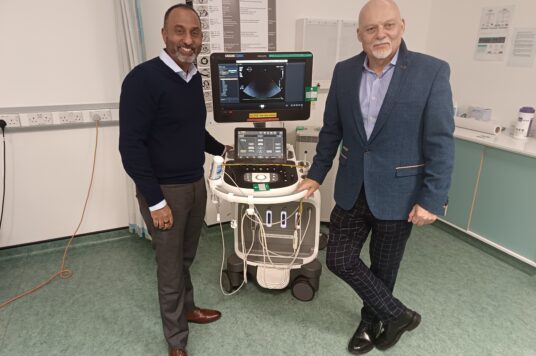
Matt with Lewis Hamilton
Matt listened to his trainer’s advice and took a bus to St George’s Hospital in Tooting, London – one of the largest cardiac centres in the south east of England – where he walked into the Emergency Department and informed the nurses he was told to get his heart checked out.
He was placed on a heart monitor, which is when things took a terrifying turn.
“The nurses asked me if I felt dizzy or light-hearted but I told them I felt absolutely fine,” Matt said.
“They then told me my heart was beating seriously slow. The chest pain I’d had when I was trying to row earlier had disappeared and I had no other symptoms and therefore no idea whatsoever that anything was wrong with me.
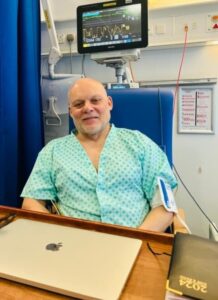
Matt in hospital
“A cardiologist was concerned by my heart rhythm, so they admitted me as an in-patient and ran what felt like millions of tests and that’s when I found out I’d had a mild heart attack and had heart disease.
“I had never been in hospital during my entire adult life and thought I was fit and strong.
“I felt as right as rain and had no idea anything was wrong with me at all. I was shocked.”
Matt was given life-saving heart pump medication and admitted onto a ward for almost a whole month. He went on to have a cardioversion – which sends controlled electric signals to the heart – to get his heart beating at a normal rate, a stent placed in his heart to keep an artery open and a pacemaker with a built-in defibrillator.
He said: “The care and kindness the staff showed me at St George’s was amazing. I was so impressed with them and I love them all.
“Being In hospital for a period gave me first-hand experience of seeing how hard the doctors and nurses work, and all the other staff too.
“I was always a fan of the NHS and now I’m an evangelist.”

Matt has praised St George’s
When Matt was discharged after 29 days, he felt overcome with emotion.
“I was blessed to go home but had a lump in my throat as I walked out of the hospital,” he said.
“I was also crying but it was tears of gratitude.
“My gratitude applies to everyone who is involved in this big, complex operation called the NHS.”
Matt was so grateful to the teams who looked after him that he felt compelled to post his thanks on social media platform X, naming 51 individual members of staff.
He added: “The NHS is fantastic – they saved my life and I won’t hear a single bad word about them.”
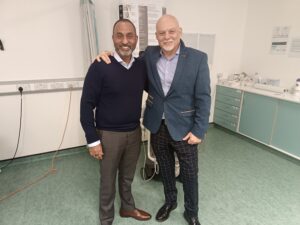
Matt with Nesan Shanmugam
Kate Slemeck, Managing Director for St George’s University Hospitals NHS Foundation Trust, said: “It’s always rewarding to hear from patients who received world-class care from our dedicated teams.
“I’m incredibly proud of the care we provide at St George’s and I’m very grateful to Matt for sharing his story.”
Consultant cardiologist Nesan Shanmugam who treated Matt added: “I am delighted to hear that Matt is doing so well.
“This story shows how important it is to listen to your body and get yourself checked out if something doesn’t feel right.”
Symptoms of a heart attack can include:
- chest pain – a feeling of pressure, heaviness, tightness or squeezing across your chest
- pain in other parts of the body – it can feel as if the pain is spreading from your chest to your arms (usually the left arm, but it can affect both arms), jaw, neck, back and tummy
- feeling lightheaded or dizzy
- sweating
- shortness of breath
- feeling sick (nausea) or being sick (vomiting)
- an overwhelming feeling of anxiety (similar to a panic attack)
- coughing or wheezing
Call 999 immediately if you think you or someone else might be having a heart attack. The faster you act, the better the chances.